
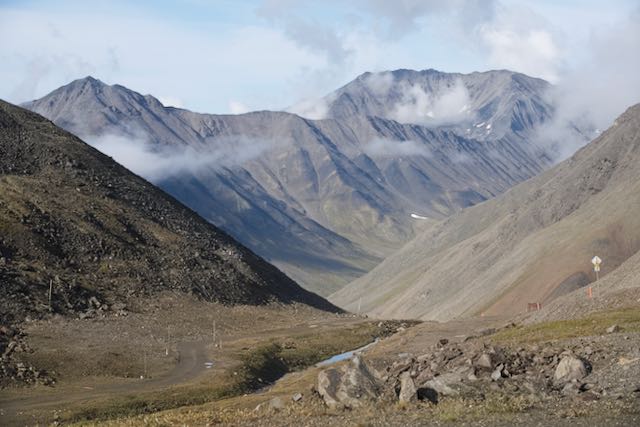
After spending the day in Fairbanks, doing laundry, checking tires, and filling the water tank, we headed towards Prudohe Bay and the Arctic Ocean. The Dalton Highway is 476 miles of mostly gravel road. Completed in 1974, the road initially banned tourist traffic. It was strictly meant for vehicles and equipment bound for Deadhorse, the uppermost town on the Dalton Highway, and its commercial gas and oil production facilities. Hence the nickname, the Haul Road, with tractor-trailer rigs hauling needed equipment and supplies to support the industry.
While still a working highway with commercial traffic having the right of way over tourists, the Haul Road soon opened to private vehicles in ???. It has been able to accommodate both populations over the years. Most truckers now accept the inconvenience of having to share the road. Most tourists also recognize that the truckers are working folks, making a living, and give priority to their positions and rigs. As an example, it is common courtesy to pull off the road to let a tractor-trailer rig pass you. Most of these trucks will outrun any vehicle on the Haul Road anyway. If nothing else it’s because they don’t own the rigs and are, therefore, more apt to chance driving fast.
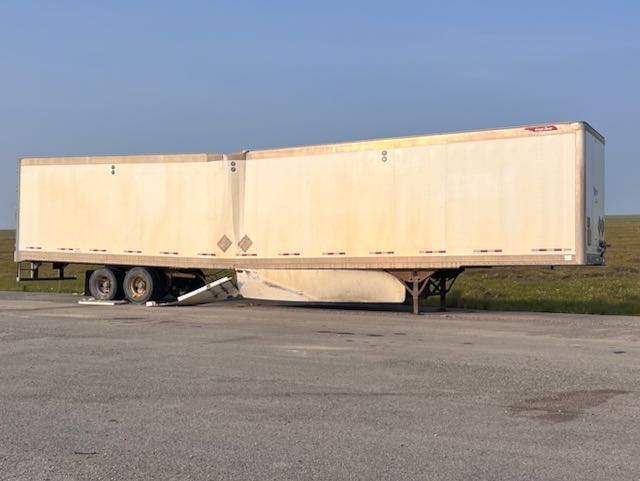
This is our fifth or sixth trip up the Dalton. Our philosophy has always been to travel safely and slowly. It has proven to be a good choice… we have never lost a tire, although the roadsides are littered with them. The road has an odd variety of toppings, including about half in gravel, some chip-seal, asphalt, and in some places just plain old dirt. The asphalt sections are often the most treacherous with miles of ice heaves, dips, broken pavement, and potholes large enough to sheer a tire. Here’s a photo of a trailer bowed in the center, broken in half from what is known as harmonic motion. If a trucker drives the continuous road heaves at a steady pace, it produces a stress rhythm in the trailer that causes the middle to collapse. Not good!
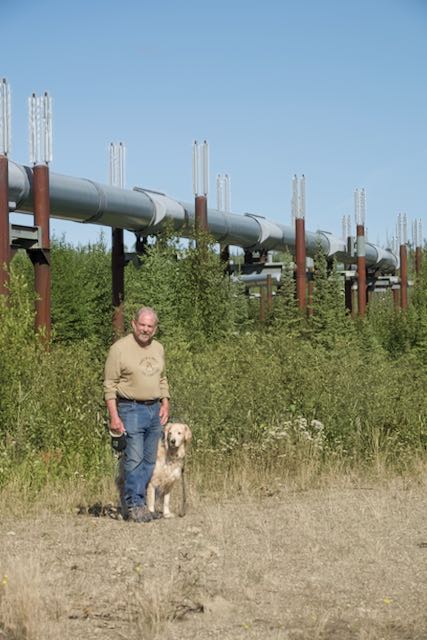
The Haul Road follows the Valdez pipeline, which runs from Prudhoe Bay to Valdez. Originally thought to be an environmental hazard, over the past fifty years, those concerns have been abated. The vegetation has recovered, and the animals have adapted well.
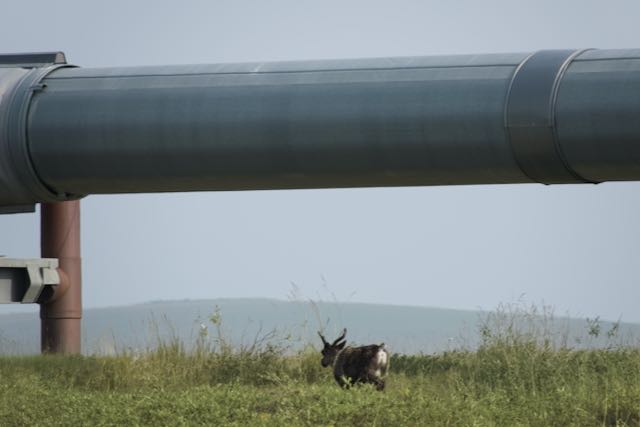
As an example, Caribou often use the warmth of the pipeline. And because it is illegal to hunt or shoot near the pipeline (for obvious reasons), the Caribou appear to have learned that the pipeline provides protection. As an example, it is now bow season, and the only Caribou we have seen have been running along the pipeline. It appears to us that they have learned to co-exist to the benefit of all.
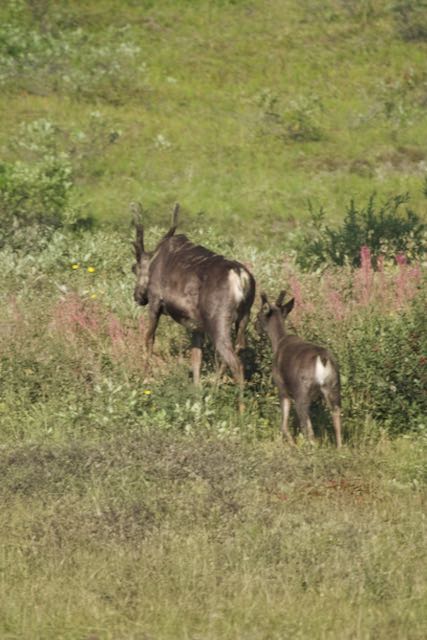
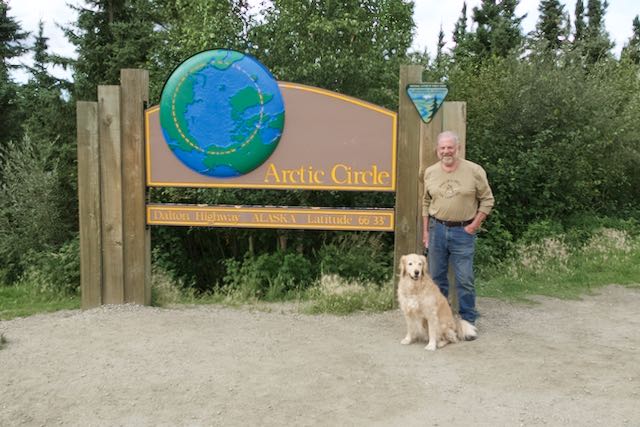
After stopping at the Arctic Circle for a photo op, we continued the long road to Coldfoot, about halfway up the Haul Road and one of two opportunities for a gasoline refill. The visitor center is well known and has a small museum in it. We stopped to check for wildlife sightings and were pleased to see some, although we were disappointed to learn that bow season had already begun. We spent the night at Marion campground, just a few miles away.
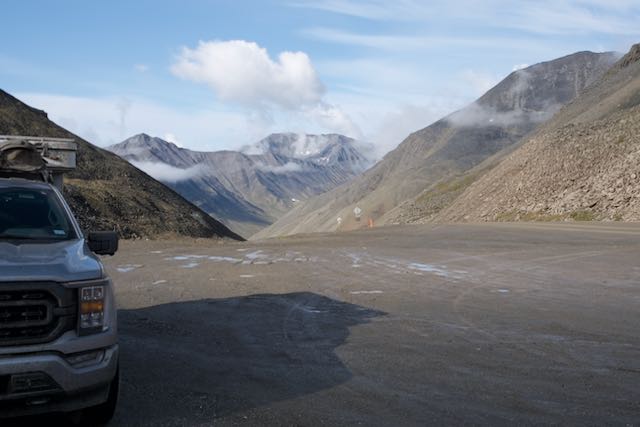
The Brooks Range is a beautiful set of mountains, which must be crossed. One of the premier highlights of the Haul Road is Atigun Pass, known for its treacherous steepness, particularly in inclement weather. The road had received rain overnight and was completely sloggy on the long approach. We put the truck in 4-wheel-drive because the backend was fishtailing. By the time we reached the summit, the road was fairly dry.
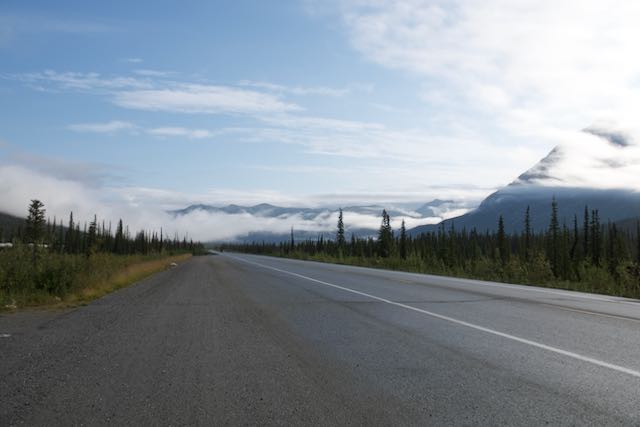
It’s an amazing transformation beyond the pass. The road levels out into the Delta, and, finally, to marshland and land so flat that you can see from horizon to horizon near the Arctic Ocean.
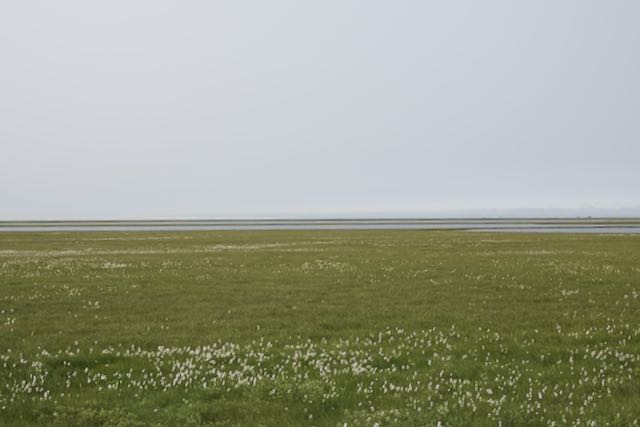
Our goal was to find the musk ox herd, and we did! Unfortunately, they were near the Franklin Bluffs, and too far for close up shots.
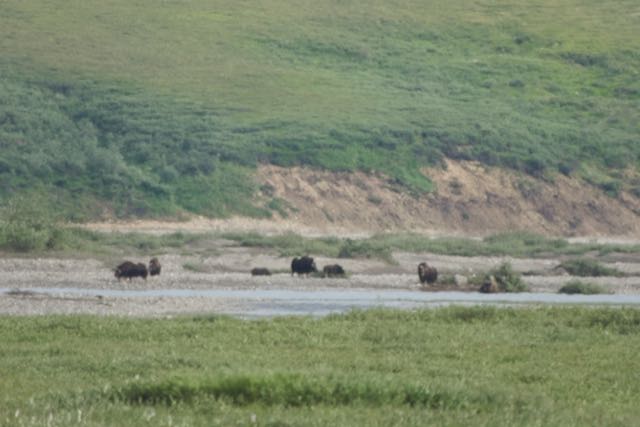
After we located the herd, we traveled into Deadhorse top off the gas tank. Gas prices in Fairbanks were $4.58 a gallon. In remote Deadhorse, it was $7.94. As a friend of ours said, “It’s still cheaper than California!”
It was a terribly chilly and windy 47 degrees in Deadhorse. Thankfully, by the time we arrived back by the musk ox, the inland temperature was 62 degrees. We popped the camper, hoping the musk ox would move closer. This is the land of the midnight sun. Sunset was 11:00 pm and sunrise at 4:30. The problem was that sun never actually sunk below the horizon. We could still read a newspaper at 2:00 am!
By morning, the musk ox had completely disappeared. All we were left with were memories of other experiences. Perhaps that is what this trip is about… reminiscing. In case you’re up for it, here’s some posts from years gone by of our encounters. Like our first trip up the Haul Road. We hadn’t seen a single critter the entire trip. Then, coming out of Deadhorse, traveling through dense fog, we saw an entire herd of musk ox on the road (see https://ruffingitx3.blogspot.com/2010/07/dalton-gang.html?m=1). Or the extraordinary trip we made when we spied a den of fox pups frolicking while mama was out hunting (see https://ruffingitx3.blogspot.com/2018/08/the-haul-road-redefined.html?m=1).
We have been so blessed over the past 16 years to experience God’s miraculous creation. From observing wild horses to being rescued by snowcats. From showering with bison, to being challenged by a momma bear who had just treed her cub. From meeting real ice road truckers to indigenous folks asking why on earth are you all the way up here? From eating moose to sourdough pancakes to Caribou sausage to schnitzel to the most incredible cinnamon buns in Tetsla. From watching northern lights and meteor showers in the dark of night to spending nights in the land of the midnight sun. From watching a Caribou migration to a ballet of plovers to dipping our toes in the Arctic Ocean. And driving from southern Texas to Alaska SEVEN TIMES… each trip special and utterly amazing!
The weather conditions seem to be preventing our wildlife encounters this year. It has been warm and dry, with temperatures steady in the 60s during the day and upper 40s at night. We’ve only pulled out our jackets one or two times the entire trip… highly unusual. The weather phenomenon is known as a “super el-Nino.” As a result, Texas will be cooler and wetter this winter, and the north will be warmer. The good news for us is that we are less likely to see hurricanes along the Gulf.
For up north, the warm weather means animals are delayed in coming down from the high country. It delays everything from rut, to hyperphagia (bears needing to pack on pounds before hibernation), and the beginning of migrations are slower. As an example, it’s amazing that our last trip in 2023 follows along our timeline almost to the day. Creamer’s Field in Fairbanks is normally teeming with Sandhill cranes this time of year. This year, however, there are only a few immature adults arriving at this point. In 2023 there were literally thousands ready to fly south. Such is the difference in weather patterns.
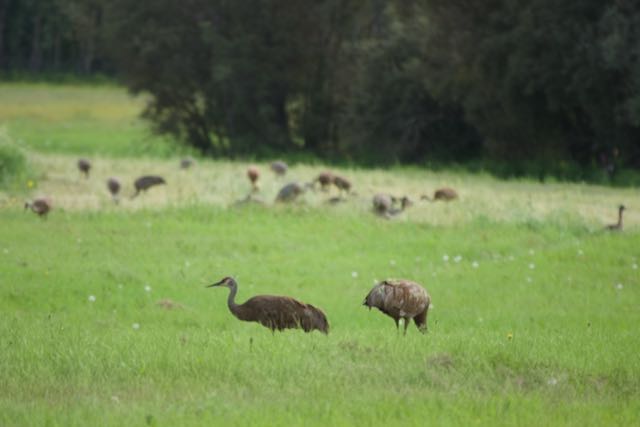
We are now back in Fairbanks, getting ready to head over the Top of the World Highway and our favorite destination on the planet… the Dempster Highway. With Alaska in our rear-view mirror, it is a bittersweet moment for me. I wonder what adventures await us next.


Leave a Reply